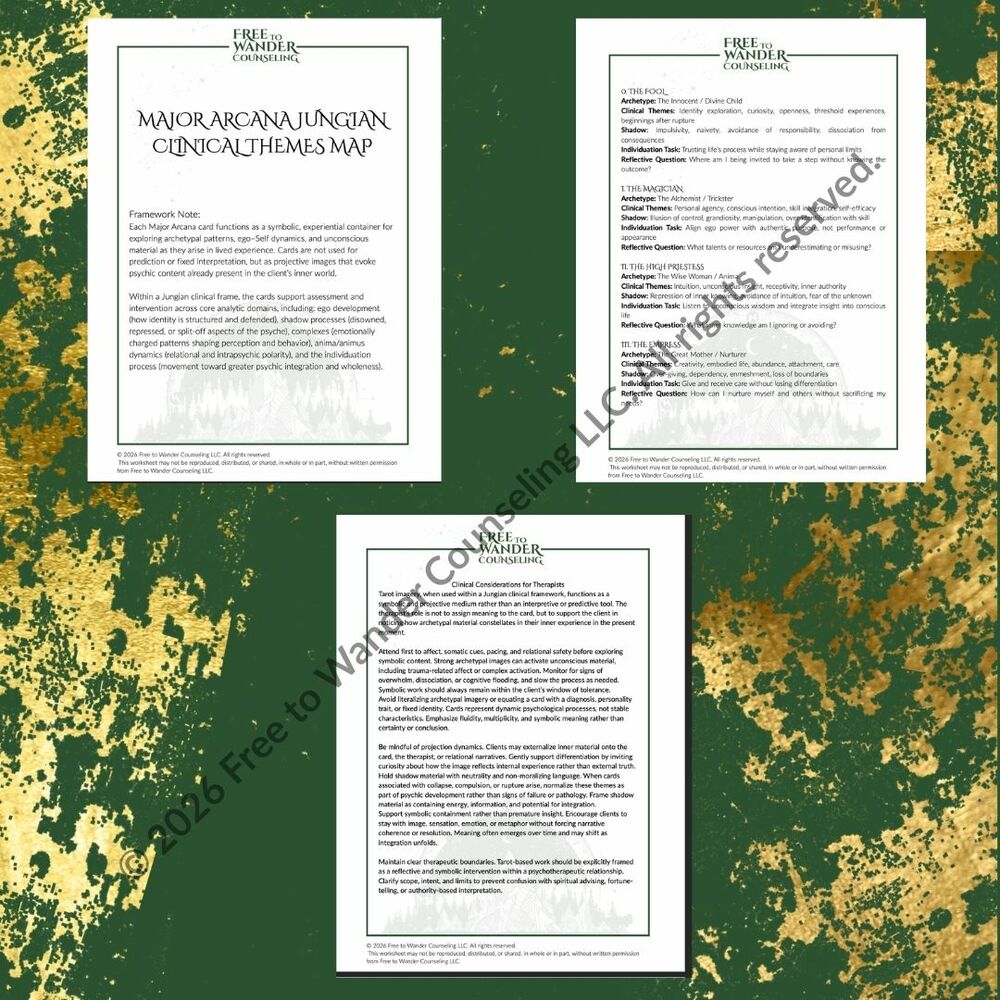
Major Arcana Clinical Theme Mapping Jungian
Major Arcana Clinical Themes Map — Jungian-Informed | Clinician and Client Framework
A structured clinical framework for therapists who want to use archetypal imagery as a portal into depth psychological work individuation, shadow integration, complex exploration, and the symbolic dimensions of the psyche. Each of the 22 Major Arcana cards is mapped to Jungian clinical themes including shadow content, persona identification, projection patterns, anima and animus material, complex activation, and the ego-Self relationship and formatted as a two-page spread designed for depth clinical use.
Major Arcana Clinical Themes Map — Jungian-Informed | Clinician and Client Framework
Page 1 — Clinician Reference The depth psychological lens for each card: archetypal themes, shadow and complex material, projection patterns, individuation implications, Jungian interventions, a guiding depth question, and a symbolic reframe. Stays with the clinician.
Page 2 — Client Take-Home An accessible, non-clinical page the client takes between sessions. Includes Simmer Questions designed to be answered and returned to as understanding deepens, journal prompts, and symbolism exploration questions. Written to honor the client's own symbolic intelligence and personal associations above any collective or theoretical meaning provided.
Also includes:
- Pull guidance — two methods for selecting a card (intuitive pull and soul pull), with clinical and depth-psychological rationale for when to use each
- Sample session setups with step-by-step clinician guidance, amplification techniques, and sample depth questions
- CBT-informed and ACT-informed versions of the instruction guide available separately
Designed for clinicians who are already doing Jungian or depth-informed work. This framework is not a guide to incorporating tarot as a modality — it is a symbolic scaffold that supports the depth work you are already doing, particularly when a client is plateauing in conscious insight, encountering shadow material that resists direct approach, or standing at a significant threshold in their individuation process.
Jung understood that the unconscious communicates through image and symbol before it speaks in words. The Major Arcana 22 archetypal figures drawn from centuries of collective human symbolic life offer a natural entry point into that register of the psyche. The card that arrives in a session, whether chosen or drawn, is treated as psychically significant: not because it predicts anything, but because the psyche is already in conversation with what it surfaces.
Tarot is used here as reflection, never prediction. The card is an image to sit with. The client's own associations are always the territory the framework is only the map.